
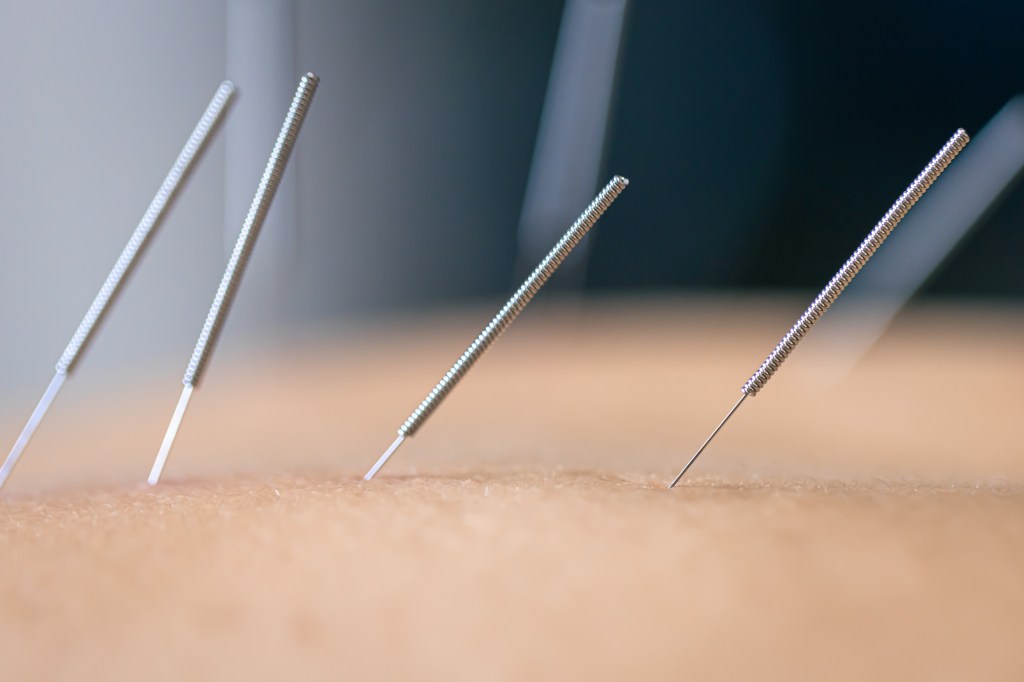
I had a dry needling massage the other day. I’ve tried it many times before – as someone who’s had stiff shoulders half her life, I’ve tried a handful of different treatments to loosen my muscles. Dry needling is similar to acupuncture in that you insert a long, very thin needle through skin and into the muscle. Acupuncture, part of Chinese traditional medicine, seeks out acupuncture points and treats meridians, believed to be the body’s energy flows. Acupuncture aims to improve the flow of energies. Dry needling is a Western, more regulated practice where the licensed dry needling therapist seeks out the tight spots in the muscles, trigger points, and manipulates them with the needle to relieve tension.
This time I went to see a new dry needling therapist. As I lay flat on my stomach, needles in my shoulders and neck, he told me about his experience doing dry needling. He’d gotten his certification seven years ago so he’s a seasoned practitioner. This coming spring, he told me, he was headed to Estonia for a special field trip for dry needling professionals. They were going to visit a pathology department. And get to see a body cut open. I could barely react as each grunt made the needles in my neck twitch; but I urged him on. He told me this was his way of deepening his own know-how to be better able to serve his customers. To heal them.
It got me thinking of any type of professional. Do we always make sure to keep our skills relevant and up-to-date? A couple years ago I watched a documentary on Netflix called “Hack your health: the secrets of your gut” in which one expert said that we should eat at least 20 different vegetables and fruit every week. This was news to me: I only knew of the five a day (in Finland, half a kilo per day). But I had never thought about the variety of it. I eat plenty of cucumber every day, but the documentary made me realise I wasn’t feeding my gut with enough microbes. I began an experiment. For two weeks, I calculated the variety and realised that I only got to about ten different greens if I didn’t pay attention. So, I started doing exactly that. Within a couple weeks of diligently eating with variety, all my gut issues were gone. Just like that.
I wondered why no one ever mentioned that when I was growing up. The obvious answer? No one knew. Science, fortunately, advances every day and we both supplement and overturn previous “knowledge.” But who makes sure professionals refresh their “knowledge?” I had seen several doctors about my gut issues, all of them asking me if I got enough water (yes), fibre (probably not, but I began taking a supplement) and exercise (mostly yes). None of them asked me about veggies. No one knows all; getting a second opinion, so familiar from American medical dramas, is common and common-sense. But more broadly, I think it’s about an individual’s desire to learn and keep getting better. Many companies and organisations have some frameworks in place to offer their members time and money to attend seminars and trainings, but most of the learning should come during the everyday. Encountering problems, seeking out solutions.
With something like dry needling, I think it’s difficult to know when and if you need to go deeper. I suppose one way to get a sense is if your customers don’t get the relief you’ve grown accustomed to seeing. Perhaps it means you’re not hitting the right spot – as my masseuse explained, the pathology department visit would be interesting as you would get to see folds of muscles and see exactly how deep you need to insert the needle to hit a muscle that’s tucked away a bit deeper.
I started thinking of my own skillset. Do I go deeper? It’s easy to get comfortable with what you already know and master. In my field, communications and marketing, you can specialise in any number of very niche things, like a specific social media platform and content format, or specialise in using a specific customer relationship management (CRM) tool. Some places seek out that specialisation, though I find most skills in what I do are transferrable. If you’ve got a hang of LinkedIn, you can probably figure our Facebook, too. If you can use Hubspot, another CRM will likely be easy to use after some practice, too. Still, even when I was in charge of LinkedIn at a company, I realised the Microsoft-owned platform was churning out new features and expiring others constantly, not always making a big number about it. Working for a fairly small company, your account rep won’t have too much interest in keeping you informed of the comings and goings of their features, so you need to stay alert. Follow specialists in the field for their eagle-eyed updates; use the platform yourself to have a real sense of what’s working; and measure results and look into sudden changes.
Go deep. You’ll be sure to hit the spot and release tension.
 Sidetracked