
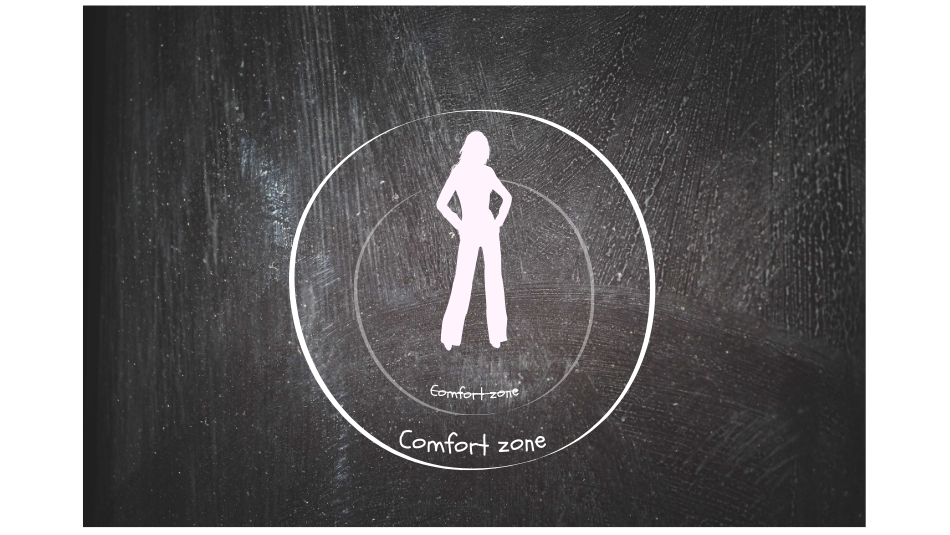
“Step outside your comfort zone.”
Everyone must have heard this advice at least a couple times in their lives. It’s fashioned as the way to grow: putting yourself out there, outside of what you are comfortable in. What I didn’t know prior to researching for this post is that it’s an actual theory used in performance management. Have a read at Alasdair White’s paper on comfort zones from 2009. White argued that there’s three zones: the comfort zone, the optimal performance zone, and the danger zone (anyone else hearing “high way to the DANGER ZONE?”). In the paper, White gives this definition of a comfort zone:
The comfort zone is a behavioural state within which a person operates in an anxiety-neutral condition, using a limited set of behaviours to deliver a steady level of performance, usually without a sense of risk.
White 2009, p. 2
The term ‘anxiety’ isn’t defined in the paper, though White states that anxiety, as motivation, is behaviourally a sub-set of stress (p. 2). He cites an experiment from 1907 by Yerkes and Dodson that found anxiety to improve performance up to a certain point (ibid.). Without delving into a full research mode, I find the use of the word ‘anxiety’ interesting as it appears to be employed positively in this context as it pushes one to leave the comfort zone towards the optimal performance zone. These days ‘anxiety’ conjures up quite negative connotations – we seem to live in an age where younger generations are plagued by anxiety and anxiety disorders appear more and more common. Doechii’s Anxiety seems to sing a tune of a feeling that tries to creep up on the singer, her trying to shake it off.
On the other hand, anxious as an adjective can also be a thrilling, energising force. “I’m anxious to see you” is positive (I think. I personally wouldn’t put it like that to someone if seeing them caused me negative anxiety, but to each their own).
White explains the purpose of motivation and/or anxiety in the context of performance and comfort zones:
to push or lead the subject into the optimal performance zone so that their skills are increased and they become comfortable with the level of anxiety, thus enabling them to consistently deliver an increase level of performance. In other words, holding the subject in the optimal performance zone for a long enough period for them to reach a new and expanded comfort zone.
White 2009, p. 2
In common parlance, we often say “step outside of your comfort zone.” I’ve always thought of it as expanding, similarly to White’s writing. Even if it’s not been true, I’ve imagined it like this: I’m standing on the edge of my comfort zone, still firmly within it, but right on the border. Through action, I push the boundary further, and the zone expands. I never step outside of my comfort zone, but what used to be unfamiliar and anxiety-inducing slowly becomes part of my comfort zone.
I first started thinking of this while living in Japan. It was a huge change for me: I’d never lived outside of Europe or in a country where I didn’t speak the language. Nor had I ever stood out just through my looks. I couldn’t hide my foreignness. I couldn’t always rely on my English or other language skills; I couldn’t always rely on behavioural cues as they were on occasion so different to what was familiar to me. Still, I didn’t feel like I was in the danger zone for most of the time as I frequently hung out with other exchange students, had help from Japanese students and studied in English (and attended Japanese class twice a week, slowly learning to manage my day-to-day with more confidence).
The Beatles Club in Japan
There was one part that did produce a lot of anxiety in me: The Beatles Club. I’d lived in Japan for a couple months when the university held an “open mic” day for all clubs to introduce their activities to new students. I spotted The Beatles Club on the list and convinced two friends to join me at the club’s event. I love The Beatles with all my heart and had long wanted to sing in a band and enjoy music with others. The students there were skilled and I managed to explain myself with a mix of English and Japanese. I recall asking the club’s president if they had any other non-Japanese speakers; he said they once had an American. I took that as a sign that I can join, and I did. I was assigned to a band made up of a few students, one of whom could speak English with me. The others were too shy to do so. It wasn’t until long after that I realised that I probably caused them as much anxiety as trying to be a part of the all-Japanese club cause me – and that the president had, in a very Japanese way, tried to dissuade me from joining. But that was a cultural cue I hadn’t yet learned. Oh well.
We started rehearsals. It turned out all the other students in my band were truly skilled at their instruments and already practised the selected songs before our first meet up – I walked in completely unprepared. I was embarrassed, for both my own reasons and for cultural ones. In Japan, to let others down through lack of preparation is to lose face; I was aware of this and the shame was compounded by my character which does not strive to disappoint. I remember bowing deeply at the end of the rehearsal, apologising for my mistake and vowing to do better next time.
The rehearsals kept going better but I did feel terrible anxiety each time I had to leave my dorm to get to campus for a jam sesh. But I kept going, using the long walk there to calm myself down, remind myself that I knew the songs inside and out, that I wasn’t pretending to be anything I wasn’t, and that everyone knew I was a foreigner – they’d forgive my flaws just for that (I mean that in a positive way here; the Japanese give a lot of leeway to foreigners as long as they act respectfully, something I admire).
On the day of our show, I felt fairly confident. I was the one who sang, and as I stood there singing, I was swaying a little. The president of the club commented on it afterwards, saying it was nice. In that moment, I felt I had truly expanded my comfort zone – and I mean expand, staying within it and pushing hard on the boundaries. Japan and Japanese were unfamiliar to me; The Beatles and singing were not. The latter provided comfort and a steady footing to push on the outskirts of my comfort zone to expand it to include singing the Beatles in a Japanese band.
Moments of Heartbeat
Instead of anxiety, a loaded term, I think of that thing that pushes me to push my boundaries as heartbeat. That excitement, mixed with nervousness. I remember going to my first job interviews, giving my first presentations, joining my first gym classes. Heartbeat. And now, there’s still that little jolt in me ahead of interviews (a sign of really caring), but no longer anxiety. I’m always firmly in my comfort zone, even when on the outskirts of it, because I know myself. Even in a wildly unfamiliar situation, I know my strengths and my weaknesses, I know how people generally operate which is a starting point. This helps me avoid danger zone where I might feel so uncomfortable that I retreat back to the very centre of my comfort zone and never leave.
 Sidetracked