
A few weeks ago, I went to an escape room with friends. Kudos to our host, an American man who stayed in character even with six Finns staring at him, incredulous and uncomfortable (‘is he playing a role or actually crazy?’).
But what really impressed me was what he said after we finished the experience. ‘Let me ask you, when you were in there, did you think about work?’ No. ‘Did you think about family issues?’ No. ‘Did you feel free of stress?’ Yup. ‘That’s what we’re selling.’
Mind. Blown.
He was right. During the eighty minutes we spent there (not quite the top result, but pretty good still), not once did I, or anyone else, think about the daily stresses we had. We were fully immersed in the world of 19th century pirates, piecing together clues and puzzles, screaming as one participant re-attached the lock we had struggled to open for fifteen minutes (admittedly, an in-game source of stress).
When we booked the experience, we just wanted to try it out and do something as a group. But as our host asked those questions and told us that what we had paid for wasn’t really what he was selling us, I started to think about value propositions. What are we really selling and buying?
On-brand branding
It’s dark outside in Finland, and while children and all manner of pets are shielded by reflectors and blinking lights, adults, true to form, believe that they will not get hit by a car even when clad in black, crossing wherever they please, headphones on. When I got my license a decade ago, I understood how terrifying it is to watch out for these happy-go-lucky ones who seem to base their faith in that illegal to run them over – sure, and when you’re dead and I’m in jail, we’ll all have a Merry Christmas.
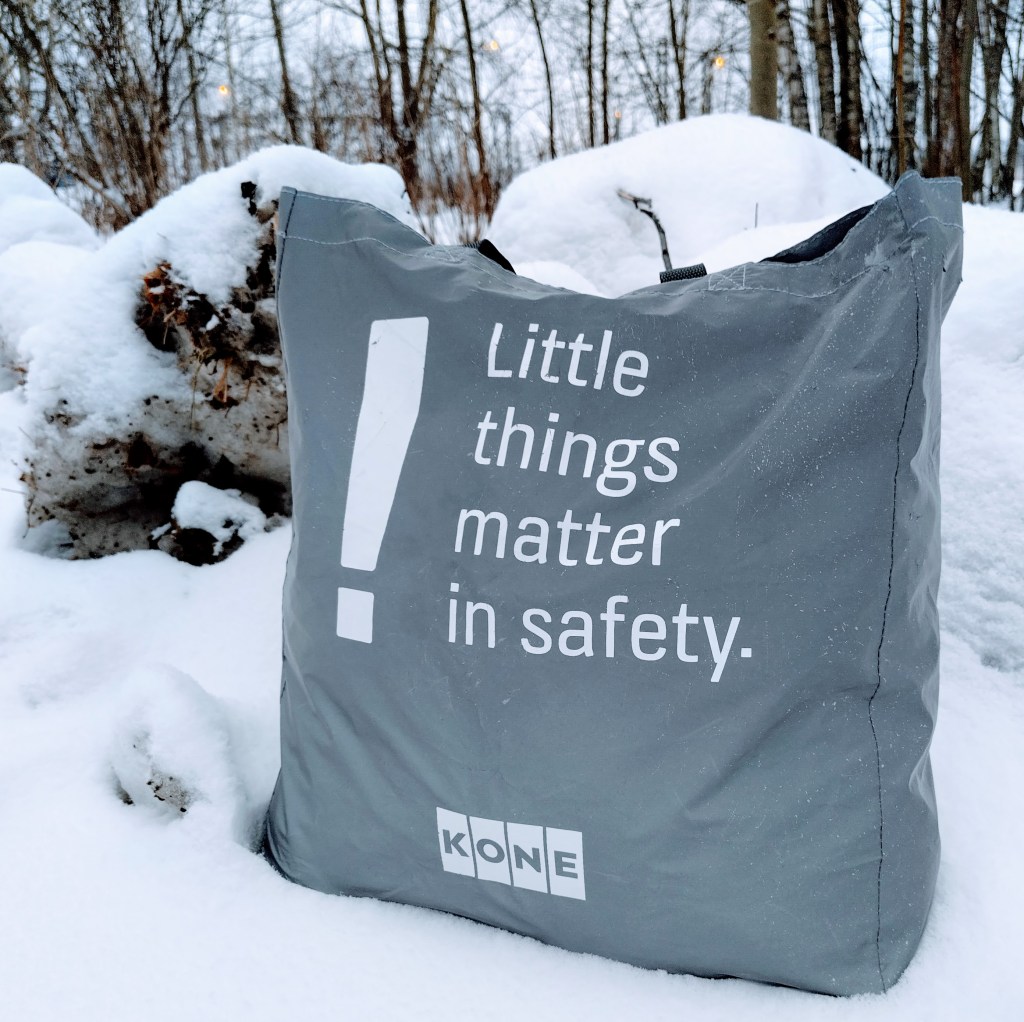
So, I try to shine some light in the dark. I use a bag I got as a farewell gift from my previous employer KONE. Its surface is fully reflecting and I use it as my gym bag – really the perfect choice when dragging myself home in the slippery darkness after an exhausting session. ‘Little things matter in safety’ is printed on the bag, and this is something that KONE sells, as I learned while working there. The industry KONE operates in is not safety (is there such an industry?) but industrial machinery manufacturing – elevators, escalators, automatic doors, and additional equipment for added efficiency and service -, but instead of offering only a box that goes up and down when you push a button, you are offered the certainty that the box will do exactly what you want, stop on the right floor, and never ever cause any danger.
Perhaps it’s obvious that an elevator ought to be safe. It’s a pretty bad elevator is you have to fear for your life every time you step in. But it’s easier to sell a concept, a solution, than an individual item. This is a well-known fact in all manner of consulting and sales, although often forgotten. A simple, even tired, example: magazine subscriptions sold over the phone. What you are sold is usually the magazine, with an offer of some sort and possibly a promotional gift. What you could be sold instead is a moment of your own, or a quick-and-easy way to learn about the world, instead of scrolling through social media? If someone can offer me a 30-minute read each week of the top things happening this week, I’ll take it.
I have worked with corporate brands, both the customer-aimed, investor-aimed, and recruit-aimed ones. They all differ because the company is trying to get different things out of the audiences. I find the reflecting bag from KONE a spot-on piece of corporate merchandise: it is functional (durable, sleek), it reminds you of the company (safe products), and it’s not too much on the nose (it doesn’t scream corporate merch nor BUY ME!).
What would the world buy? What can you sell?

I’ve tried many frameworks for finding my true calling in this world. Ikigai is one of them, this Venn diagram sections the search in four. I am brutely proceeding from corporate branding to personal branding, but I was in all honesty reminded of this Ikigai diagram when I thought about the buying and selling concept.
I’m also thinking of one of the most basic concepts of economics, supply and demand. Do we buy what’s out there, or do new things appear out of a need for them? Which one drives which? In the real world, it’s both, often in complex ways.
Let’s think of the two examples I’ve written about in this post, the escape room and the elevator manufacturer. Do we really need escape rooms? Not really. Do we really need escalators and elevators? Yes. But are both selling a value proposition worth buying? Yes, at least to me. The escape room sells, well, an escape from your daily life and routines, the same way as books, movies, music and sports. It’s the experience that you are buying, and it’s great that we can get that from many sources (not everyone enjoys puzzles). KONE, while its core product may be machinery that gets you from spot A to spot B, sells safety, and as its slogan, a smooth people flow.
I’ve always found it difficult to find my ikigai, to glue the morsels I sprinkle on each circle together. The world needs so many things that I’m not good at, and I love doing many things no one would pay me for. Or so I tell myself, hopefully mistakenly. I don’t have any words of wisdom to offer you or myself about branding and ikigai, but I hope something starts brewing. Your specific skill may be the one you get money for, but what comes out of the skill is what you may want to sell for others to buy it.
 Sidetracked